


Emotionally intelligent UX design is the next competitive advantage in digital banking. Discover how emotional trust gaps are silently driving customers away and how to close them. Modern financial technology excels in precision and performance, yet many customers still hesitate before tapping “Confirm”. That pause isn’t about technology; it’s about trust.
The Emotional Trust Gap in Digital Finance
Behind every digital banking milestone lies a quiet, persistent challenge: the emotional trust gap.
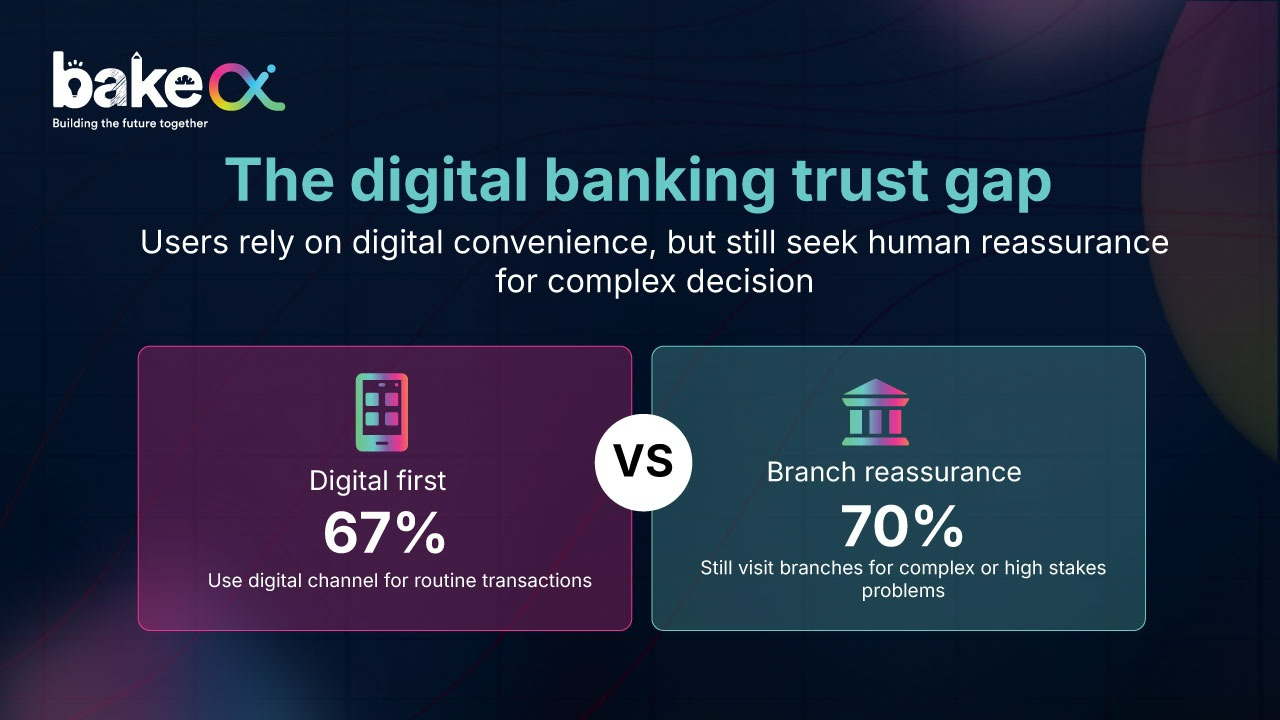
A 2024 Accenture Global Banking Consumer Study revealed that while 67% of users rely on digital channels for routine transactions, over 70% still visit branches for reassurance when faced with complex or high-stakes problems.
In other words digital platforms deliver convenience, but not always confidence.
Financial apps today often feel functionally perfect yet emotionally distant. Users move through them like machines, not humans. They crave more than speed; they seek clarity, empathy, and emotional certainty.
A Deloitte survey found that emotional satisfaction contributes twice as much to customer loyalty as ease of use. Yet, emotional design remains one of the most underinvested areas in banking UX.
Trust, therefore, isn’t a design trend. It’s a strategic advantage — one that determines whether users stay loyal or silently drift away.
Why Emotional Design Matters in Banking
Money is emotional. It carries security, pride, anxiety, and hope — often all at once.
When financial experiences neglect those emotions, users subconsciously sense something’s off. They don’t describe it in words, they simply hesitate.
Studies show that customers interpret design cues – tone of voice, responsiveness, micro-interactions – as indicators of institutional trustworthiness. An inconsistent button color can trigger doubt just as much as a vague message about fees.
Emotionally intelligent UX acts as an invisible layer of comfort — bridging logic with empathy, and data with reassurance.
The Three Stages of UX Maturity in Modern Banking
The evolution towards emotionally intelligent design unfolds through three recognizable stages.
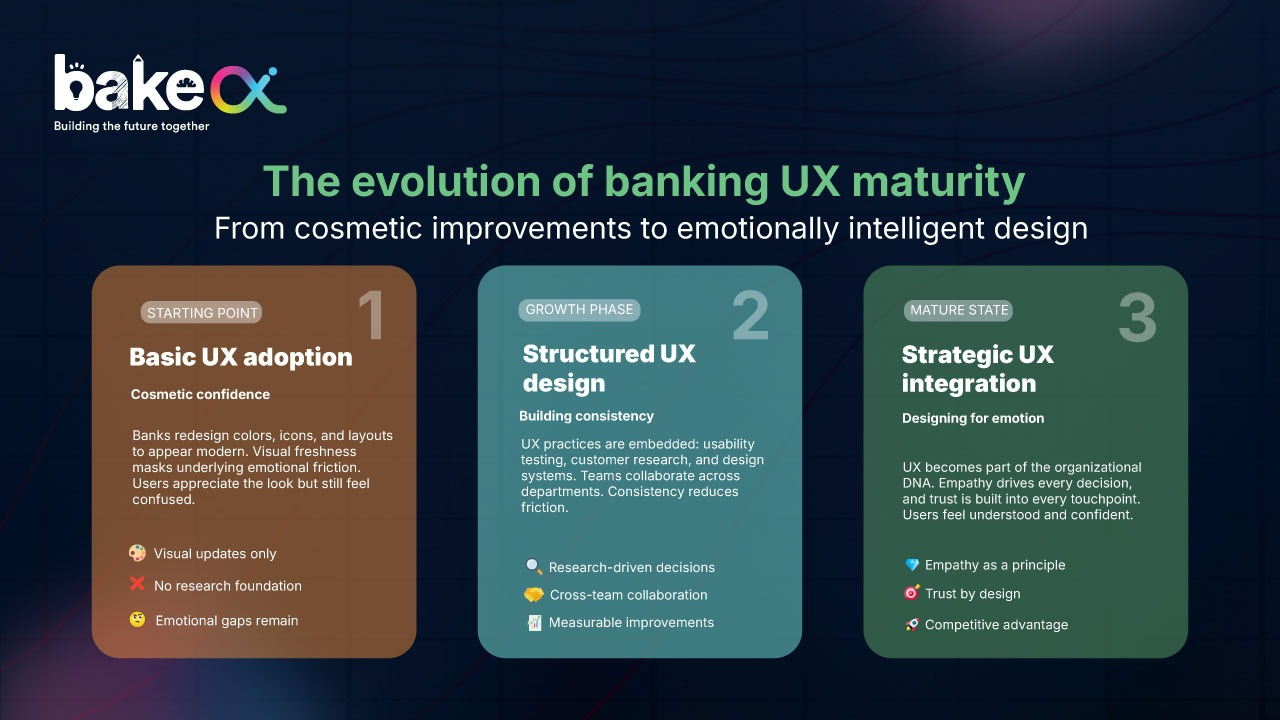
Stage 1: Basic UX Adoption: Cosmetic Confidence
Many banks start here — redesigning colors, icons, and layouts to make interfaces look current. But visual freshness rarely addresses underlying emotional friction.
Users may appreciate the new look but still feel confused by unclear fees or uncertain transaction states. The bank appears modern yet still feels mechanical.
Stage 2: Structured UX Design: Building Consistency
This stage marks a turning point. Banks begin embedding UX practices: usability testing, customer research, and design systems. Teams collaborate across IT, marketing, and compliance. Visual and functional consistency emerges, reducing friction and improving clarity.
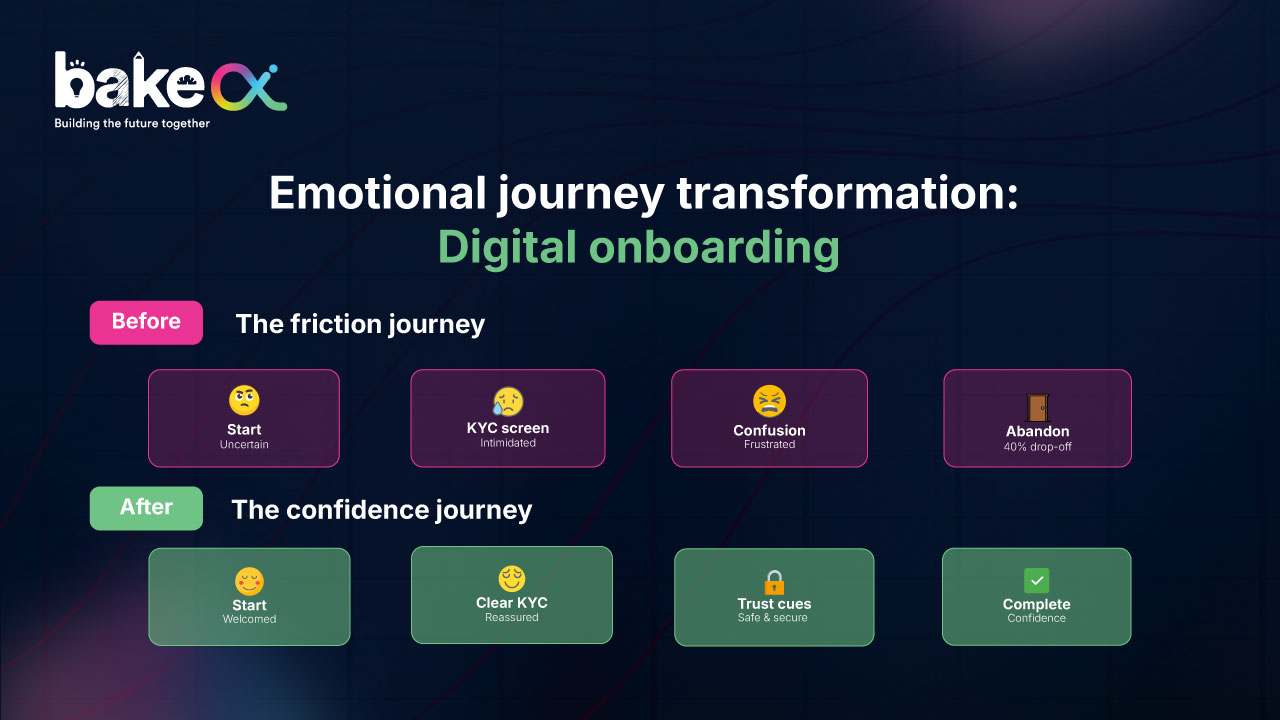
Real-world impact: A regional bank noticed that 40% of customers abandoned the onboarding flow mid-way. Post-research, they discovered emotional triggers — confusing instructions and intimidating KYC screens.
The solution: Simplifying language and adding reassuring feedback (“Your information is safe and encrypted“).
The result: Completion rates improved by 60%.
Stage 3: Strategic UX Integration: Designing for Emotion
Here, UX becomes part of the institution’s DNA. Empathy isn’t an add-on, it’s a decision-making principle.
Designers, compliance officers, and developers co-create experiences that balance regulation with human comfort. Every touchpoint, from loan applications to fraud alerts, communicates transparency and calm.
BakeCX Case Study: A leading GCC-based financial institution partnered with BakeCX to reimagine its digital ecosystem. Instead of beginning with screens, the team began with sentiment mapping; understanding customer emotions during critical banking actions like payments, investments, and complaints.
Key insight: People didn’t fear technology; they feared uncertainty.
BakeCX restructured flows to anticipate those moments, clarify messages, and design micro-interactions that gently guide users forward.
The measurable impact:
- Increased trust and digital engagement
- Reduced support escalations by 30-40%
- Higher customer satisfaction scores
- Improved completion rates across critical flows
- All driven by design empathy.
From Cosmetic to Cultural: Building Emotionally Mature UX
Transitioning from interface updates to emotionally intelligent ecosystems require deep cultural change, not just design change.
- Executive Empathy: Leaders must experience the product as users do — feeling every frustration, hesitation, and moment of delight. Real empathy at the top drives organizational alignment below.
- Data-Driven Empathy: Analytics reveal what users do; behavioral research explains why. Combining both uncovers the emotional triggers behind friction, fear, or confusion.
- Cross-Functional UX Integration: Embedding UX professionals within every department, product, technology, risk, and compliance — ensures that trust is designed in, not retrofitted.
- Design Systems That Speak Emotion: A design system is more than colors and components; it’s a shared emotional language. Consistency across tone, spacing, and microcopy cultivates subconscious comfort.
- Continuous Emotional Feedback Loops: UX maturity doesn’t end at launch. Regular user interviews, A/B testing, and sentiment analysis reveal new trust gaps as markets evolve.
What Emotionally Intelligent UX Delivers
When empathy becomes a measurable practice, the outcomes are both human and commercial.
- Increased Loyalty: Emotional connection boosts retention rates up to 50% (PwC 2023).
- Operational Efficiency: Clear design reduces user error and lowers support tickets by 30–40%.
- Regulatory Clarity: Trust-centric design aligns compliance messaging with transparency.
- Brand Differentiation: Competitors can copy features — not feelings.
The Future of Finance Runs on Customer Trust
As digital ecosystems multiply, technology will soon become equal across the industry. The real differentiator will be emotional design; how a product makes people feel safe, respected, and understood.
The next generation of banks will compete on trust experience, not user experience. Interfaces will become quieter, more transparent, and more human — like conversations, not commands.
At BakeCX, we see design not as art, but as empathy translated into logic. We design the feeling of trust.
Ready to Humanize Your Digital Banking Experience?
If your company is ready to move beyond usability and toward genuine connection, our team at BakeCX partners with banks and fintech to embed emotional intelligence into every digital interaction.
Connect with us:
● Email: info@bakecx.com
● LinkedIn: https://www.linkedin.com/company/bakecx