


Poor digital banking user experience silently damages customer trust. Here is where it starts and how to fix it.
Customer trust in banking is rarely lost because of a single incident. In most cases, it erodes gradually through everyday digital interactions that feel unclear, inconsistent, or unreliable. As digital banking platforms become the primary channel for customer engagement, digital banking user experience has become a direct determinant of trust.
Banks often assume trust is protected by strong security, compliance, and brand reputation. However, customers evaluate trust differently. For them, trust is shaped by how confi dently they can complete everyday tasks—checking balances, transferring money, paying bills, or reviewing transaction history—without hesitation or uncertainty.
This is why poor user experience directly impacts customer trust in banking, even when systems are technically sound.
UX Signals That Quietly Trigger Trust Loss
Trust erosion does not begin with major failures. It begins with subtle UX signals that customers may not consciously articulate but instinctively respond to.
Across digital banking platforms, the most common trust-weakening UX signals include:
● unclear success or failure states after transactions
● inconsistent interaction patterns across similar journeys
● delayed or missing system feedback during critical actions
● repeated authentication or verification loops
● transaction histories that lack clarity or context
In BakeCX’s work with financial institutions across mature and emerging markets, these signals consistently appear long before customers disengage. While each issue may seem minor in isolation, their repetition creates a perception of unreliability.
Transaction Uncertainty Has the Highest Trust Impact
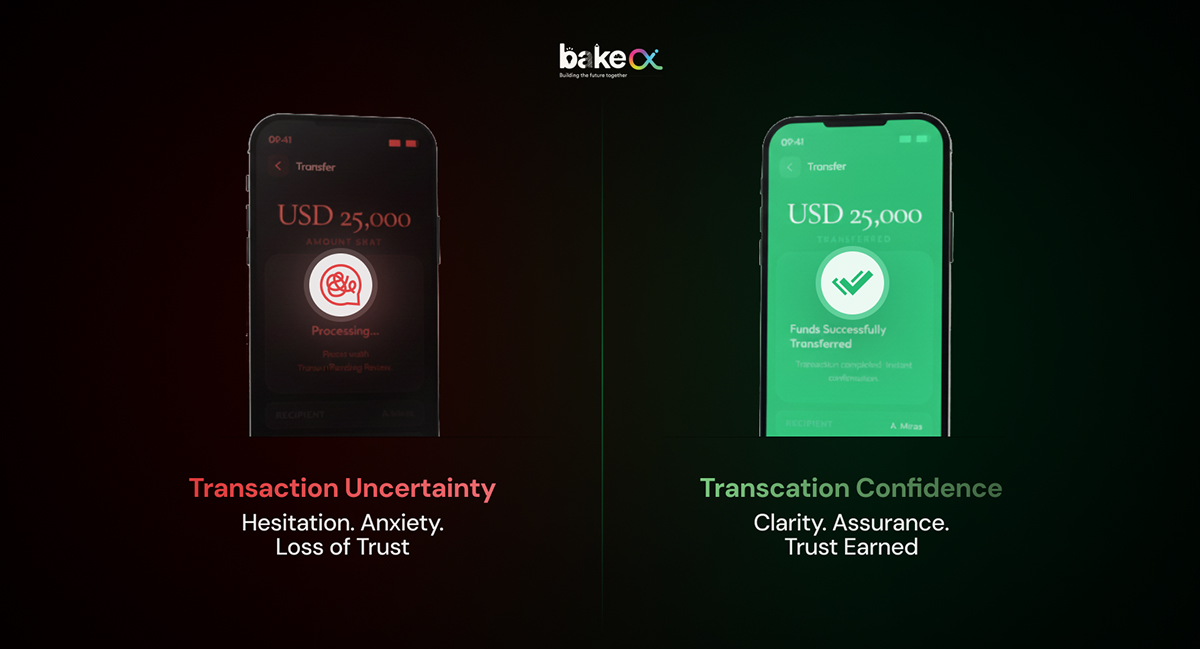
Among all UX failures, transaction uncertainty has the most immediate and measurable impact on trust in banking apps.
Customers can tolerate feature limitations, but they struggle with uncertainty when money is involved. When a transfer takes longer than expected without explanation, or when confirmation messages are unclear, customers experience anxiety at the moment they expect reassurance. In multiple BakeCX-led UX audits, transaction-related journeys were responsible for:
● Upto 40–55% of trust-related complaints
● A significant rise in repeat transaction attempts
● Increased reliance on call centers for confirmation
Importantly, these issues were rarely caused by transaction engines. They were caused by experience gaps—unclear states, poor feedback timing, and inconsistent confi rmation logic.
By addressing these gaps through clearer status indicators, predictable timing expectations, and improved error recovery fl ows, banks were able to reduce uncertainty without touching backend systems.
UX Failures and Complaint Volume Are Strongly Correlated
Banks often treat complaint volume as an operational issue. In reality, complaint volume is frequently an experience indicator. In projects reviewed by BakeCX, complaint spikes typically followed breakdowns at three UX points:
1. immediately after submitting a critical action
2. during authentication and verifi cation flows
3. when customers could not clearly interpret transaction history
When UX clarity was improved at these points, banks observed:
● 25–35% reduction in support queries related to digital channels
● Lower escalation rates for routine transactions
●Improved customer confi dence in self-service journeys
This reinforces a critical insight: customers contact support not because systems fail, but because experiences fail to explain outcomes clearly.
Experience Consistency Is a Leading Indicator of Trust Health
Trust in banking apps strengthens when experiences behave consistently. Experience consistency means:
● similar actions follow similar logic
● outcomes are communicated in familiar ways
● users don’t need to relearn flows across journeys
From a banking app usability perspective, inconsistency introduces cognitive effort and cognitive effort erodes trust.
BakeCX typically addresses experience consistency through:
● Journey standardization across high-frequency tasks
● Design system alignment for states, labels, and feedback
● Reduction of unnecessary steps in repeat actions
● Consistent confirmation, receipt, and reference patterns
When consistency improves, trust improves naturally. Customers complete tasks faster, rely less on support, and re-engage with digital features more confidently.
How Banks Cope With Trust Erosion Caused by Poor UX
When customer trust in banking begins to decline, the solution is rarely a full redesign or platform replacement. In most cases, trust can be stabilized by correcting experience mechanics at the journey level.
The approach BakeCX applies typically includes:
1. identifying trust-leak journeys (transfers, bill payments, beneficiary management, login, transaction history)
2. measuring task-level behavior such as drop-offs, retries, and time-to-completion
3. prioritizing transaction clarity and recovery paths
4. enforcing experience consistency across similar actions
5. validating changes through usability testing before broad rollout
This method allows banks to restore trust without disrupting existing systems, while improving both engagement and operational efficiency.
Is poor UX quietly weakening trust in your banking app?
If your digital platform is functional but customers still hesitate, the issue is often clarity, consistency, and transaction confidence—not features. A focused UX review can reveal where trust begins to erode and what to fix first.
Submit your requirements to info@bakecx.com. Our team responds within 1–2 working days.